
Every year, tens of thousands of people taste something they made in their kitchen and think: I should sell this. Most never do. Of those who try, the majority fail within two years — not because the product wasn't good, but because they didn't understand how different the food industry is from every other startup.
This guide exists to close that gap.
What follows is the most complete, operationally honest breakdown of how to bring a food product from idea to retail shelf. We will cover market validation, commercial formulation, regulatory requirements, co-manufacturing, distribution strategy, and the funding realities most guides gloss over. Whether you are launching a better granola bar, a functional beverage, or the next plant-based breakthrough, the fundamentals are the same.
There are no shortcuts here. But there is a clear path.
Table of Contents
- Validate Your Concept Before You Spend Anything
- Map the Market and Understand the Competitive Landscape
- Define Your Product Precisely
- Move From Kitchen Recipe to Commercial Formula
- Navigate FDA Regulations and Labeling Requirements
- Build Your Brand and Packaging
- Select a Co-Manufacturer or Production Partner
- Run Shelf-Life Testing and Food Safety Validation
- Get Into Distribution
- Fund Your Brand Without Killing It
- The Mistakes That Kill Food Startups
- Realistic Timeline and Cost Breakdown
- FAQ
Step 1: Validate Your Concept Before You Spend Anything
The most expensive mistake in the food industry is spending $40,000 to formulate and produce a product that nobody will buy. Validation should happen before you develop anything.
What Validation Actually Means
Validation is not asking your friends if your hot sauce is good. It is confirming that a segment of real consumers will pay money for your product at the margin you need to run a sustainable business.
The three questions every food concept must answer:
- Is there a real problem? Does your product solve a pain point (too much sugar, poor protein quality, no convenient option in this category) or serve a genuine desire (authentic regional flavor, indulgence without compromise)?
- Is the market large enough? Niche is fine. Invisible is not. A category with fewer than $50M in annual sales will struggle to support an emerging brand.
- Can you win on the shelf? If the top three brands have $50M marketing budgets and national distribution, entering undifferentiated is not a strategy, it is a donation.
Low-Cost Validation Methods
Farmers markets and pop-up events are the most underrated research tools in the industry. You get real-time price sensitivity data, purchase intent, and unfiltered feedback — all at the same time. If you cannot sell your product face-to-face at $8, you probably cannot sell it on a shelf at $9.
Direct-to-consumer (DTC) pre-orders allow you to validate willingness to pay before you produce anything. A landing page, a simple checkout form, and targeted social ads can tell you more in two weeks than six months of focus groups.
Retail buyer conversations come later, but starting early is fine. Call your local specialty grocery, natural food co-op, or regional chain buyer. Buyers will tell you, with brutal honesty, whether your concept fits a gap or fills a shelf that is already overcrowded.
The Validation Threshold
Before investing in commercial development, aim for at least one of the following:
- $5,000 in verified pre-orders or sales
- 3 letters of intent from buyers willing to take the product at a target retail price
- Demonstrated sell-through above 80% at a repeated farmers market or event
If you cannot hit any of these benchmarks, the product needs refinement — not investment.
Step 2: Map the Market and Understand the Competitive Landscape
Once you have validated that someone will buy your product, you need to understand who else is competing for that same consumer and what the real economics of your category look like.
Category Research
Spend time in the stores where you want to sell. Not online. In person. Walk every inch of the aisle. For each competing product, record:
- Retail price and package size (this tells you the price ceiling)
- Ingredient panel and label claims (this tells you what the market standard is)
- Brand positioning (who is the product talking to, and how?)
- Shelf placement (eye level is premium; bottom shelf is clearance)
Understand Retailer Economics Before You Talk to a Buyer
Food retail is not like other retail. Buyers do not simply stock products they like. They make decisions based on category performance, margin requirements, and reset schedules.
Key terms you need to understand:
- Slotting fees: Many retailers (especially conventional grocery) charge brands upfront fees to secure shelf space. These can range from a few hundred dollars per SKU at a local chain to $10,000+ per SKU at national conventional grocery.
- Scan-based trading: Some retailers do not pay you until the product scans at checkout. You own the inventory on the shelf.
- Distributor margin: If you go through a distributor (UNFI, KeHE, regional DSD), they typically take 15%–30% of the wholesale price.
- Retailer margin: Most grocery retailers expect 35%–50% margin on your product.
If your retail price is $10, and the retailer takes 45% and the distributor takes 25%, you receive roughly $4.12 per unit. If your cost of goods is $3.00, you are left with $1.12 to cover marketing, overhead, and profit. This math is the business model. Know it before you launch.
The Competitive Positioning Matrix
Map your competitors across two axes: price (value to premium) and benefit (functional to indulgent). Find the white space. The goal is not to be the best product in a crowded quadrant — it is to be the obvious choice in an underserved one.
Step 3: Define Your Product Precisely
Vague products fail. Before any formulation work begins, you need a written product brief that defines what you are building with precision.
The Product Brief
A product brief is a single document that answers:
- Category: What type of product is this? (RTD beverage, bar, sauce, supplement, frozen entree)
- Format: What is the package? (12oz can, 2oz shot, 6oz squeeze pouch)
- Target consumer: Who is buying this and why? One person, described specifically.
- Sensory targets: Flavor profile, texture, color, and aroma expectations in plain language.
- Nutritional targets: Specific macro/micronutrient goals (e.g., "25g protein, under 5g sugar, no artificial sweeteners").
- Label claims: What will you put on the front of pack? (Organic, Keto, Non-GMO, Gluten Free, Vegan)
- Target shelf life: How long does the product need to last and under what storage conditions?
- Target COGS: What can you afford for the product to cost to manufacture?
- Launch SKU count: How many flavors or varieties in year one?
This document becomes the north star for all technical work. Every formulation decision, every ingredient choice, every manufacturing specification flows from it.
Step 4: Move From Kitchen Recipe to Commercial Formula
This is the step that most founders underestimate. Your kitchen recipe is not your commercial formula. It is your inspiration.
Why Kitchen Recipes Do Not Scale
When you make something at home, you are working at the most forgiving scale imaginable. You can taste as you go, adjust the heat second-by-second, and fix a broken emulsion with a quick whisking. At a co-manufacturer running 2,000 units per hour, none of that is possible.
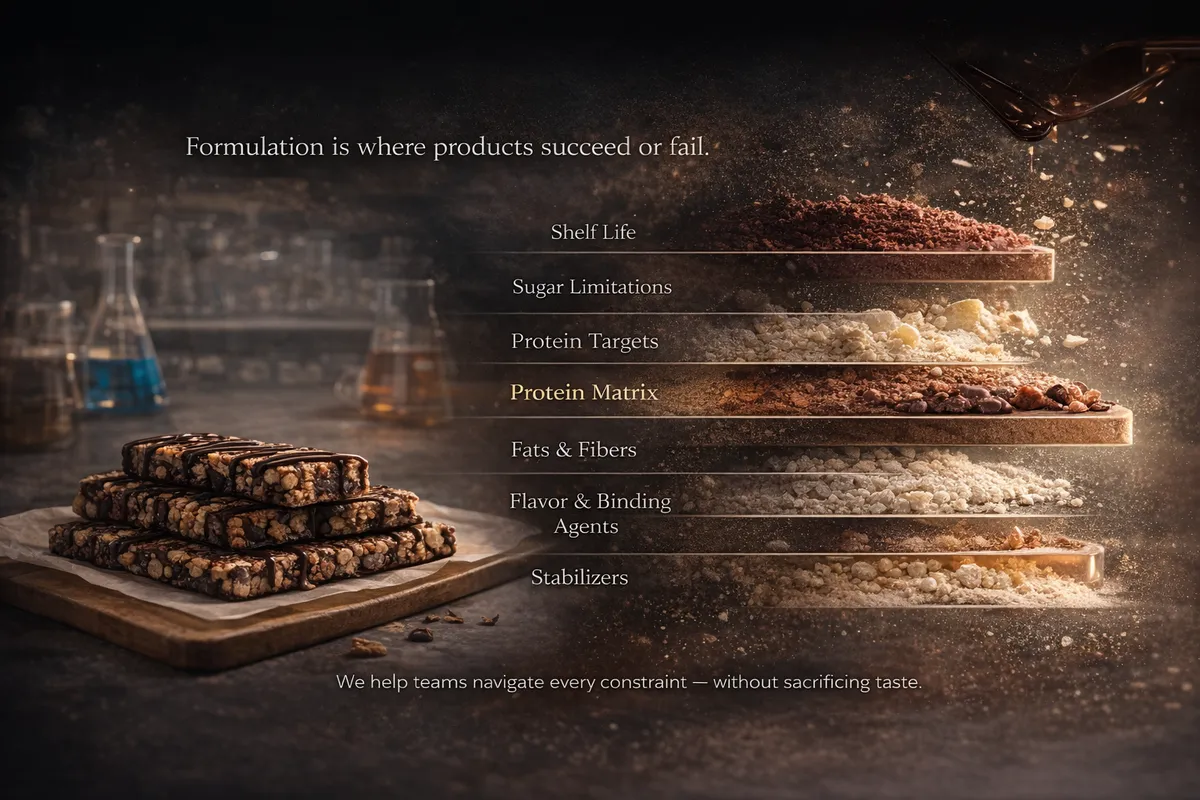
Commercial formulation must account for:
- Process tolerances: A heat exchanger applies heat differently than a stovetop. A high-shear mixer applies shear differently than a hand blender. Your ingredients must survive the equipment.
- Scaling physics: Viscosity, mixing time, and heat transfer do not scale linearly. A sauce that takes 10 minutes to reach proper consistency in a 5-gallon batch may take 45 minutes — or fail entirely — in a 500-gallon kettle.
- Ingredient standardization: Fresh garlic becomes garlic powder. Fresh citrus becomes citric acid and natural flavor. Every swap must be tested for sensory equivalence.
- Water activity and pH: These are the primary drivers of shelf stability and microbial safety. Your home recipe has no reason to track them. Your commercial formula must.
- Order of addition: In complex emulsions, protein beverages, and sauces, the sequence in which ingredients are added determines whether the product succeeds or separates.
What a Food Scientist Actually Does
A food scientist takes your product brief and your sensory inspiration and builds a formula that will:
- Hit your taste and texture targets consistently at scale
- Remain stable and safe across your target shelf life
- Survive the specific processing equipment your co-manufacturer runs
- Meet your nutritional and label claims with validated analytical data
- Stay within your COGS target
This work involves benchtop prototyping (making small-scale batches in a lab), sensory evaluation (structured tasting protocols, not just "does this taste good"), and accelerated shelf-life testing.
The number of iterations required varies significantly. Simple dry-blended products (protein powders, spice blends) may need 5–10 iterations. Complex emulsified beverages or high-moisture products with clean-label preservation systems often require 20–40 iterations before reaching a stable, scalable formula.
The Gold Standard vs. The Commercial Prototype
Define two versions of your product early:
The Gold Standard is your ideal — the version made with the best possible ingredients, no constraints. It is the 10/10. It is the sensory target everything else is measured against.
The Commercial Prototype is the version that survives the supply chain. It uses standardized, spec-certified ingredients. It has a validated microbial profile. It fits your COGS. It may score an 8.5/10 on your Gold Standard benchmark — and that is the goal. A successful commercialization closes as much of that gap as possible without over-engineering fragility into the formula.
Key Formulation Considerations by Category
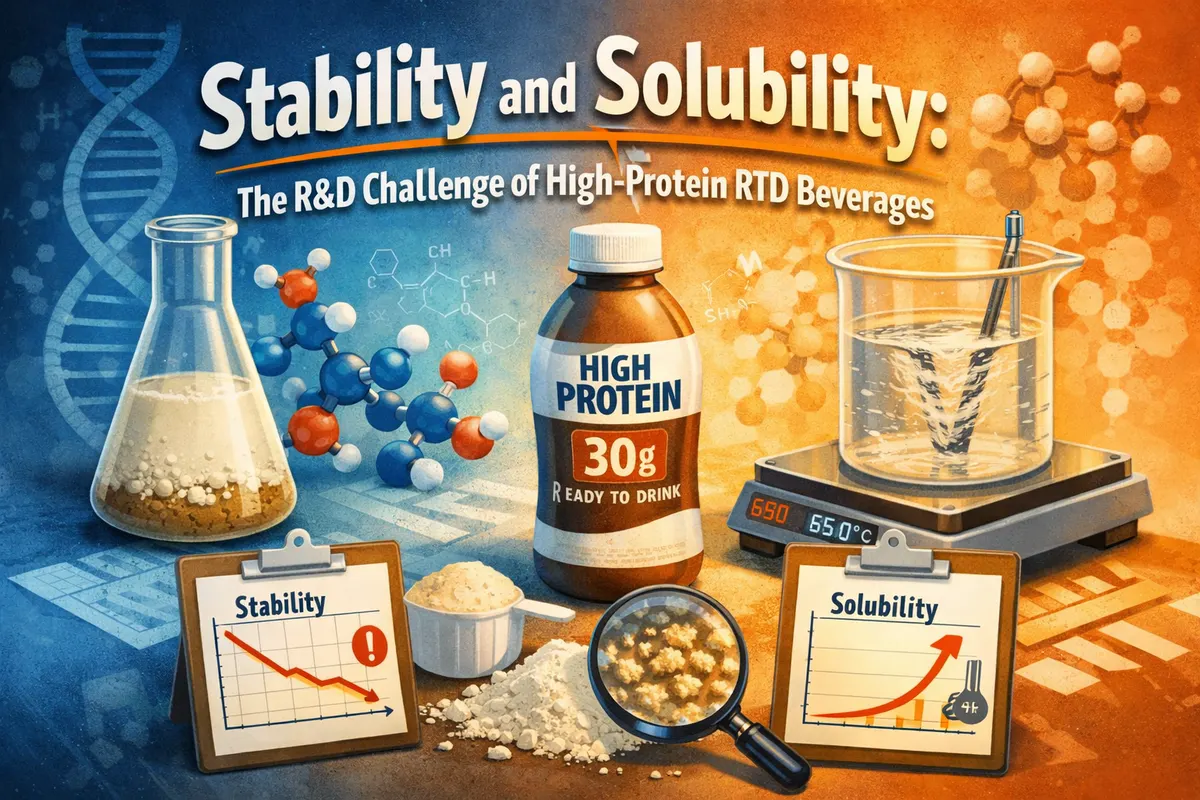
Beverages (RTD): pH control and thermal processing are everything. A beverage below pH 4.6 can use Hot Fill or HPP. Above 4.6, you are in low-acid territory and need UHT or retort processing — a fundamentally different co-manufacturing infrastructure. Know this before you design the formula.
Bars and snacks: Water activity (aw) is the critical parameter. Products above aw 0.85 require hurdle technology (pH, preservatives, modified atmosphere) or refrigeration to remain safe. Bars typically target aw below 0.65 for ambient stability.
Sauces and condiments: Emulsion stability and pH management. A vinaigrette that holds in a jar for 12 months requires a different emulsifier system than one made fresh in a kitchen. Xanthan gum, modified starch, and lecithin are common tools — each with trade-offs in label perception and cost.
Supplements and functional products: Bioavailability and ingredient interactions matter as much as taste. Mineral fortification (iron, calcium) can disrupt stabilizer networks and cause off-flavors. Probiotic products require cold-chain unless you have microencapsulated strains validated for ambient stability.
Step 5: Navigate FDA Regulations and Labeling Requirements
The US food regulatory environment is complex, and the consequences of getting it wrong are severe — from warning letters to product recalls. This section covers what every food founder needs to know.
FDA vs. USDA Jurisdiction
Most food products fall under FDA jurisdiction. However, meat, poultry, and egg products are regulated by USDA/FSIS. If your product contains any meat or poultry ingredient (including broths and stocks), you are in USDA territory, which involves a different labeling standard and mandatory inspection protocols.
Nutrition Facts Panel Requirements
Every packaged food product sold in the US requires a Nutrition Facts panel that complies with FDA 21 CFR 101. Common mistakes that result in enforcement action:
- Incorrect serving size: Serving sizes are reference amounts customarily consumed (RACC), not what you decide is a serving. The FDA defines RACC by category.
- Rounding errors: Nutrient values must be rounded according to specific FDA rules. Many founders use generic software that applies incorrect rounding.
- Calorie calculation: Calories are calculated from declared macros using Atwater factors — not directly from bomb calorimetry. If your macros are wrong, your calories are wrong.
- Vitamin and mineral declarations: The 2020 Nutrition Facts rule requires declaration of Vitamin D and Potassium. Vitamin A and Vitamin C are now voluntary.
Do not use a nutrition label generator for a commercial product. Have your formula analyzed by an accredited laboratory or a registered dietitian with regulatory experience. The FDA takes label accuracy seriously.
Front-of-Pack Claims
Front-of-pack claims (the large text on the front of your package) are heavily regulated.
- "Excellent source of protein" requires 20% or more of the Daily Value per serving, based on PDCAAS-corrected protein values — not just grams.
- "Low sugar" and "no added sugar" have specific FDA definitions. "Low sugar" is not an FDA-defined nutrient content claim — do not use it without qualified legal review.
- "Natural" has no formal FDA definition and is the subject of ongoing enforcement scrutiny. If your product contains high-fructose corn syrup, artificial flavors, or synthetic preservatives, do not use "natural" on the label.
- "Keto," "Paleo," "Whole30" and similar diet claims are not FDA-regulated terms, but they invite consumer expectations that your product must meet. Using "keto" on a product with 15g net carbs per serving is a brand trust problem, not just a regulatory one.
Organic and Non-GMO Certification
USDA Organic certification is managed by accredited certifying agents and requires full supply chain traceability of certified ingredients. It is a significant operational commitment. If you want to use the USDA Organic seal, certification must be in place before launch — you cannot claim "certified organic" and apply later.
Non-GMO Project verification is a third-party program, not a government certification. It is widely recognized by consumers and required by some retailers (notably Whole Foods Market). The verification process involves documentary review of each ingredient's sourcing and typically takes 3–6 months.
Facility Registration and Food Safety Plans
Under the Food Safety Modernization Act (FSMA), any facility that manufactures, processes, packs, or holds food for US consumption must register with the FDA. If you are using a co-manufacturer, they are responsible for their own registration and facility compliance — but you are responsible for your product's food safety plan.
A Food Safety Plan (required under FSMA for most food producers) includes:
- Hazard analysis (biological, chemical, physical, and radiological)
- Preventive controls for identified hazards
- Monitoring, corrective action, and verification procedures
- Recall plan
If your co-manufacturer is SQF, BRC, or FSSC 22000 certified, they will have a robust food safety program in place. Review their most recent audit report before signing any production agreement.
Step 6: Build Your Brand and Packaging
Your packaging is your most powerful salesperson. On a retail shelf, you have approximately 1.5 seconds to communicate what your product is, who it is for, and why it is worth picking up.
Brand Strategy Before Design
Before you hire a designer, you need to answer:
- Brand voice: Is this brand warm and approachable? Technical and expert? Bold and disruptive? Quiet and premium?
- Visual language: What colors, typography, and imagery represent this brand in the consumer's world?
- Name: Is it available as a trademark? Search the USPTO trademark database, check domain availability, and search Instagram and TikTok before you fall in love with a name.
Packaging Design Principles That Drive Sales
Hierarchy: The most important information (brand name, primary claim, flavor/variety) should be visible at arm's length. Secondary information (secondary claims, certifications) at a foot. Full details (ingredient panel, Nutrition Facts) at reading distance.
Signal vs. noise: More information on a package does not mean better communication. Most premium food brands use negative space intentionally. If everything is emphasized, nothing is.
Substrate and format selection: The physical package (pouch, can, jar, box, bottle) must match both the product's requirements and the consumer's usage occasion. A compostable kraft pouch signals premium and sustainability but cannot be used for high-water-activity products without a liner. A glass jar signals craft and quality but adds weight, cost, and breakage risk in shipping.
Regulatory requirements for the label: Certain elements are required by law — product identity, net weight, manufacturer name and address, ingredient list, Nutrition Facts, and any required allergen declarations. These are not optional, and their placement is sometimes specified (e.g., net weight must appear on the principal display panel).
Packaging Lead Times
One of the most commonly missed timeline factors: custom packaging has long lead times. Printed pouches, shrink sleeves, and custom cans are typically ordered in large minimums (5,000–50,000 units) and have 8–14 week lead times from final artwork approval to delivery.
Do not wait until you have a final formula to start packaging design. Run packaging development in parallel with formulation work. Design for the 95% likely formula and adjust only if a major technical pivot forces a change.
Step 7: Select a Co-Manufacturer or Production Partner
Unless you are planning to build or lease your own manufacturing facility (a capital-intensive decision that most early-stage brands should avoid), you will need a contract manufacturer — commonly called a co-manufacturer or co-packer.
What a Co-Manufacturer Does
A co-manufacturer is a facility that produces your product using your formula, your specifications, and sometimes your ingredients. You provide the recipe, the quality standards, and the packaging. They provide the equipment, the labor, the facility, and the food safety infrastructure.
How to Find a Co-Manufacturer
Start with these resources:
- PMMI's food processing equipment database
- Co-Manufacturers.com and CoPacker.com
- Industry trade shows (Expo West, IFT, Pack Expo) — the best co-packers have booths and are actively looking for brand partners
- Your ingredient supplier's account manager — they know every facility running their ingredients and will often make warm introductions
- Your food scientist or R&D consultant — experienced consultants maintain active relationships with vetted facilities
Do not rely solely on a Google search. Many of the best co-packers do not have significant online presence because they are already running at capacity.
Evaluating a Co-Manufacturer: The Three Pillars
1. Technical and Process Capability
Before any discussion of price, confirm they can physically produce your product. Ask specifically:
- What thermal processing equipment do you operate? (UHT, HTST, Hot Fill, HPP, retort)
- What mixing and homogenization equipment is available and at what capacities?
- What packaging formats and fillers do you run?
- Have you produced a product similar to mine? Can I taste it and see the line specifications?
If the answers are vague, walk away. A co-packer who cannot articulate their process capability cannot protect your product quality.
2. Quality Systems
A third-party food safety certification (SQF Level 2 or 3, BRCGS, FSSC 22000, NSF GMP) is the minimum. Then go deeper:
- Ask for their most recent third-party audit score. A score below 85% on SQF is a red flag.
- Ask for their last mock recall and the results. Any credible facility runs mock recalls quarterly.
- Ask about allergen changeover protocols. Cross-contact is the fastest path to a recall.
- Visit the facility. Look at the floors, the drains, the gaskets on the equipment. Sanitation standards that are invisible in a sales presentation are visible in a facility walk.
3. Commercial and Cultural Alignment
The best technical co-packer will still fail your brand if the business terms do not work.
- Minimum Order Quantities (MOQs): If they require 50,000 units per run and your launch plan is 10,000 units, you are either taking on massive inventory risk or the relationship does not make sense yet.
- Pricing and yield loss: Understand what you are paying per unit and who absorbs the cost of yield loss (material wasted during startup and cleanup). On a new product's first run, 7%–12% yield loss is normal and should be negotiated into the agreement.
- Capacity and priority: If you are a $200K per year account and their top client is a $50M per year account, your production slot will be bumped without hesitation when there is a scheduling conflict. Find a facility where your volume represents 10%–20% of their capacity — large enough to matter, small enough to grow.
When to Consider a Shared-Use Kitchen or Incubator
For very early-stage brands (pre-Series A, under 5,000 units per month), a licensed shared-use commercial kitchen or food incubator is often the right starting point. Facilities like these allow you to produce and sell legally under your own license, at small volumes, without co-manufacturer MOQs.
This is a valid first step — not a permanent solution. Production economics at kitchen-scale are poor (high labor cost per unit, inconsistent throughput), and retail buyers will eventually require proof that you can fulfill at volume. Use this stage to validate product-market fit and build cash flow, then transition to a co-manufacturer as demand warrants.
Step 8: Run Shelf-Life Testing and Food Safety Validation
This is the most skipped step by first-time founders and the most common source of catastrophic failure.
Why Shelf Life Cannot Be Estimated
You cannot calculate shelf life from your formula. It must be tested. Product degradation — microbial, chemical, and sensory — is non-linear and depends on a dozen interacting variables: pH, water activity, packaging barrier properties, processing temperature, storage conditions, ingredient interactions, and more.
Regulatory shelf-life requirements depend on product type:
- Products making FDA-regulated nutrient content claims must meet declared nutrient levels through the best-by date.
- Products regulated as low-acid canned foods (pH >4.6 in hermetically sealed containers) require a scheduled process review by a Process Authority before commercial production.
- Refrigerated products with extended shelf life (14+ days) require validation under the FDA's refrigerated foods guidance.
Accelerated Shelf-Life Testing (ASLT)
Waiting 12 months for real-time stability data before launch is not viable. Accelerated Shelf-Life Testing (ASLT) uses elevated temperature and humidity conditions to predict shelf-life in a compressed timeframe. A product stored at 40°C/75% RH for 4 weeks provides an approximation of behavior at ambient conditions over a longer period.
ASLT is a predictive tool, not a replacement for real-time data. Always run real-time validation in parallel. Use ASLT to make launch decisions; use real-time data to confirm them.
Microbial Validation
Your product must be proven safe. Depending on your category and processing method, microbial testing typically includes:
- Aerobic plate count (APC): Total microbial load
- Yeast and mold count: Critical for high-moisture products
- Coliform and E. coli: Indicators of sanitation failures
- Listeria and Salmonella: Required for many ready-to-eat products
- Challenge testing: For products making pathogen control claims or using novel preservation systems
Work with an accredited food safety laboratory. Do not rely on in-house or unaccredited testing for safety validation.
Start Shelf-Life Testing Early
The single most important advice in this entire guide: begin shelf-life testing before your formula is finalized. Run accelerated stability on your best prototype while you continue optimizing. Discovering a stability failure at month 3 of a 12-month validation cycle — after you have already committed to packaging and a co-manufacturer trial — is a catastrophe. Discovering it at month 3 of a 12-month development cycle is a solvable problem.
Step 9: Get Into Distribution
Retail distribution is the part of the food business that surprises founders most. You do not simply contact a store and ship product. There is an entire ecosystem of intermediaries, timelines, and margin structures to navigate.
Distribution Models
Direct Store Delivery (DSD): You or a contracted driver delivers product directly to individual stores. Common in beverages, fresh products, and local brands. Requires route infrastructure and significant time investment. High cost per store at small scale; more economics at regional scale.
Distributor (UNFI, KeHE, regional distributors): A wholesale distributor buys your product, warehouses it, and sells it to retailers. They take a 15%–30% margin. They also require demos, promotions, and in some cases slotting fees. Getting into UNFI or KeHE does not get you onto shelves — it gets you into their warehouse. You still have to sell the retailers.
Specialty/natural channel: Whole Foods Market, Sprouts, Natural Grocers, and regional natural chains are the target for most emerging brands. These buyers are category-focused, values-aligned, and willing to take bets on emerging products — but they have high velocity expectations. A product that does not sell through at rate will be discontinued.
Online (DTC and Amazon): Direct-to-consumer online channels offer higher margins and direct consumer data but require significant marketing investment to drive traffic and manage fulfillment complexity. Amazon's FBA (Fulfilled by Amazon) program is viable for non-perishable products and provides access to a massive audience, but competition is fierce and Amazon's margin requirements are significant.
The Retail Buyer Conversation
When you are ready to approach a buyer, you need:
- A sell sheet: One page, clearly showing your product photo, key claims, retail price, wholesale price, case pack configuration, and UPC codes.
- A sample: The actual product, in final packaging. Never show a prototype at a buyer meeting.
- Your velocity story: How is the product performing where it is already being sold? Buyers want to see proof of concept — even small data (farmers market sell-through, DTC reorder rates) is better than nothing.
- A promotional plan: Buyers want to know how you will drive traffic to their shelf. What demos, digital ads, influencer partnerships, or PR will you bring?
Timing matters enormously. Most retail chains operate on category reset schedules — typically annual or biannual windows when new products are evaluated. Ask the buyer when the next reset is for your category and plan your outreach accordingly.
Building Velocity Before Pitching Chains
The most common mistake emerging brands make is pitching national chains before they have built local velocity. A Whole Foods buyer who asks "where else are you selling?" is not making small talk — they are evaluating whether you can drive consumer demand or whether they would be subsidizing your brand development.
Build velocity in your local market first. Own your region. Then expand regionally. Then pitch national. The brands that try to skip from zero to national scale without a velocity story almost always fail to hold shelf space even when they get it.
Step 10: Fund Your Brand Without Killing It
The food and beverage industry is capital-intensive. Formulation, testing, packaging, and a first production run can easily cost $50,000–$200,000 before you have sold a single case to a retailer. Understanding your funding options and their trade-offs is essential.
Self-Funding (Bootstrapping)
Bootstrapping means using personal savings, revenue, or friends-and-family capital to fund growth. It preserves equity and forces financial discipline. The constraint of limited capital also forces clarity — you focus on the revenue-generating activities, not the exciting ones.
Many successful food brands were bootstrapped through regional distribution before taking outside capital. If you can build $500K–$1M in annual revenue on your own, you are in a dramatically stronger position to negotiate with investors.
Revenue-Based Financing and Credit
For brands with demonstrated revenue, revenue-based financing (Clearco, Assembled Brands, others) provides capital against future revenue without equity dilution. Traditional SBA loans are available but require collateral and have limitations on use of funds. Business credit lines can bridge the gap between production runs and retailer payment cycles.
Do not underestimate working capital needs. Many brands get into retailers, produce product, and then run out of cash because they cannot wait 60–90 days for the retailer to pay them. Your co-manufacturer needs to be paid at production. Your distributor pays you 30–60 days after they sell to the retailer. That gap will destroy a well-selling brand that is not capitalized for it.
Angel Investment and Venture Capital
Angel investors (high-net-worth individuals) and CPG-focused venture capital funds (Prelude Growth, Almanac Insights, Trail Mix Ventures, Siddhi Capital, and many others) invest in consumer brands at various stages.
To attract outside investment, you need:
- A differentiated product with validated consumer demand
- Revenue history with a clear upward trajectory
- A compelling unit economics story (contribution margin positive or a credible path to it)
- A founder team with relevant expertise or demonstrated ability to learn
Consumer venture is more patient than software venture — CPG companies are rarely "unicorns" in the traditional sense — but investors still expect a credible path to $50M+ in revenue within 5–7 years to justify the risk.
Accelerators and Incubators
CPG-focused accelerators (SKU, Chobani Incubator, Whole Foods LEAP Program, and others) provide capital, mentorship, and in some cases, direct retail access. The trade-offs include equity dilution and significant time commitment. These programs are most valuable to founders who need operational mentorship and network access as much as capital.
The Mistakes That Kill Food Startups
Understanding the most common failure modes is as valuable as understanding the success path.
1. Launching before shelf-life validation is complete. Product that fails in the field — separation, color change, off-flavors, microbial growth — generates returns, chargebacks, and brand damage that early-stage companies cannot absorb.
2. Underestimating cost of goods. Building a brand on a COGS that does not leave enough margin to support marketing, distribution, and operational overhead is not a formula problem — it is a business model problem. Model your full P&L before you produce anything.
3. Buying too much inventory on the first run. Co-manufacturers push founders toward larger runs because their economics favor it. Resist. A 50,000-unit first run that underperforms in market creates a write-down. A 10,000-unit run that sells quickly gives you data, confidence, and a re-order cycle.
4. Over-investing in the wrong channel. Conventional grocery chains require slotting fees, promotional spending, and demo budgets that emerging brands cannot afford. Natural specialty retailers, direct-to-consumer, and foodservice are lower-barrier first channels for most early-stage brands.
5. No food safety plan. A recall at any scale damages your brand, your retail relationships, and in some cases your ability to relaunch. The cost of prevention (proper testing, a certified co-manufacturer, a food safety plan) is orders of magnitude less than the cost of response.
6. Trying to do everything yourself. Formulation, regulatory, packaging design, brand strategy, sales, operations — no single person executes all of these at a high level. The founders who succeed build the right team and relationships early.
Realistic Timeline and Cost Breakdown
What It Costs
There is no single number that applies to every product. But here is an honest range for a first-time founder launching a single SKU through a co-manufacturer into specialty retail:
- Formulation and development (food scientist / R&D): $8,000 – $40,000 depending on complexity
- Laboratory testing (nutrition panel, micro, shelf-life): $3,000 – $10,000
- Packaging design: $3,000 – $15,000 for professional brand identity and package design
- Packaging production (first run): $5,000 – $25,000 depending on format and quantity
- Co-manufacturer trial run: $3,000 – $10,000
- First commercial production run (product + packaging): $15,000 – $80,000 depending on category, volume, and COGS
- Certifications (Organic, Non-GMO, Kosher, Halal): $1,000 – $5,000+ depending on certifications pursued
- Total (realistic first-year all-in): $75,000 – $250,000+
This is why validation matters so much before you invest. The cost of launching a product no one wants is the same as the cost of launching one they love — but only one of them comes back.
FAQ
Q: Do I need a food scientist to launch a food brand?
A: For any product that requires shelf-life stability, specific nutritional claims, or is made at commercial scale, yes. A food scientist is not a luxury — it is how you avoid recalls, regulatory issues, and production failures that cost ten times what the scientist would have. That said, for simple products (dry spice blends, fresh-baked goods sold locally), you may be able to work with a smaller consulting engagement rather than a full-scale development contract.
Q: How do I get my product into Whole Foods?
A: Whole Foods buyers review products on a regional basis. The entry point for most emerging brands is regional buyer outreach — not the corporate buyer. Research the regional buyer for your category (the Whole Foods website lists regional buying contacts). You need a product in final packaging, demonstrated local velocity, and ideally a story that fits Whole Foods' brand values. The LEAP Local program is specifically designed for regional emerging brands and can be a faster path than the standard buyer process.
Q: Can I produce my product in my home kitchen?
A: In most states, cottage food laws allow the sale of certain low-risk products (baked goods, jam, candy) made in a home kitchen, but with significant restrictions: direct-to-consumer sales only, annual revenue caps, and a list of permitted product categories. Most shelf-stable products intended for retail sale require production in a licensed, inspected commercial facility. Check your state's cottage food laws before assuming you can sell commercially from a home kitchen.
Q: What is the biggest mistake founders make with co-manufacturers?
A: Choosing based on price alone. The cheapest co-packer that cannot execute your formula's processing requirements is actually the most expensive option — because when the product fails, the cost is paid in returns, recalls, and lost shelf space, not in a line item on a purchase order.
Q: How do I protect my formula?
A: Your formula can be protected by trade secret law without any formal registration — as long as you treat it as confidential. Use NDAs with any contract manufacturer, lab, or consultant who sees the formula. Do not send your formula in an email without an NDA in place. For truly novel formulations or processing methods, a utility patent may be appropriate, but this is expensive and the claims must be genuinely novel. Most food formulas are not patentable — trade secret protection and trade dress (your brand's distinctive look and feel) are the more practical tools.
Q: When should I start talking to investors?
A: When you have a product, a market, and proof that consumers will pay for it. "I have an idea" is not fundable. "I have $300K in revenue growing at 40% month-over-month with a 58% gross margin" is. Build the business first. Investors are much easier to find once you have something to show.
Summary
Starting a food brand is one of the most rewarding and most humbling entrepreneurial paths you can take. The product you make feeds people. The brand you build becomes part of people's daily lives. That matters.
But the path from kitchen inspiration to retail shelf is not a straight line. It runs through food science, regulatory compliance, manufacturing operations, retail economics, and brand strategy — disciplines that most founders have to learn on the fly while also running a business.
The founders who succeed are not the ones with the best recipe. They are the ones who take the time to understand the industry before they dive in, build the right relationships at each stage, and are willing to iterate without ego.
Start with validation. Invest in formulation. Take regulatory seriously. Choose your manufacturing partner carefully. Build velocity before scale. And find experts who have done this before — not to hand the work over, but to avoid the mistakes that only experience can see coming.
Ready to Build Something Real?
Whether you have a napkin concept or a formula that needs to get to market, we work with food founders at every stage. We've helped brands go from kitchen prototype to retail launch — and we know where the landmines are.
"They gave us an honest assessment of what it would actually take to launch — no sugarcoating, no upselling. That honesty was exactly what we needed to make smart decisions with our budget."
— Founder, Emerging CPG Brand